
1st Workshop Edition, 2019
Navigating social and commercial objectives in social enterprise
Running your own business is hard, but it can be especially difficult for people who want to set up a social enterprise, aimed at having a positive impact on people and the planet. How is this done, and how do you get over the tension between commercial and social objectives? In this workshop, we draw on our research to give workshop attendees the tools to understand the tensions they face, and how they can find a way to navigate through this.
2nd Workshop Edition, 2020
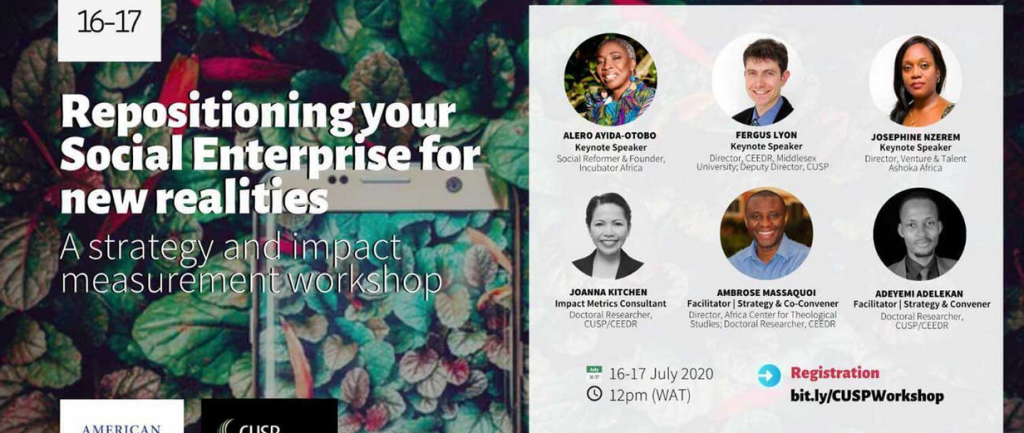
Repositioning your social enterprise for new realities: A strategy and impact measurement workshop
Social enterprises need to run a good business while also finding ways to have a positive impact on people and the environment. With the long-term impact of the current crisis on global economies yet to be understood, these enterprises are more likely to suffer after the lockdown due to severe constraints to their operations or even bankruptcy. What will this mean for social enterprises in African countries and how do you prepare your organization for this potentially new reality? This virtual workshop enabled social entrepreneurs to reflect on their strategies and the impact they make.
3rd Workshop Edition, 2021
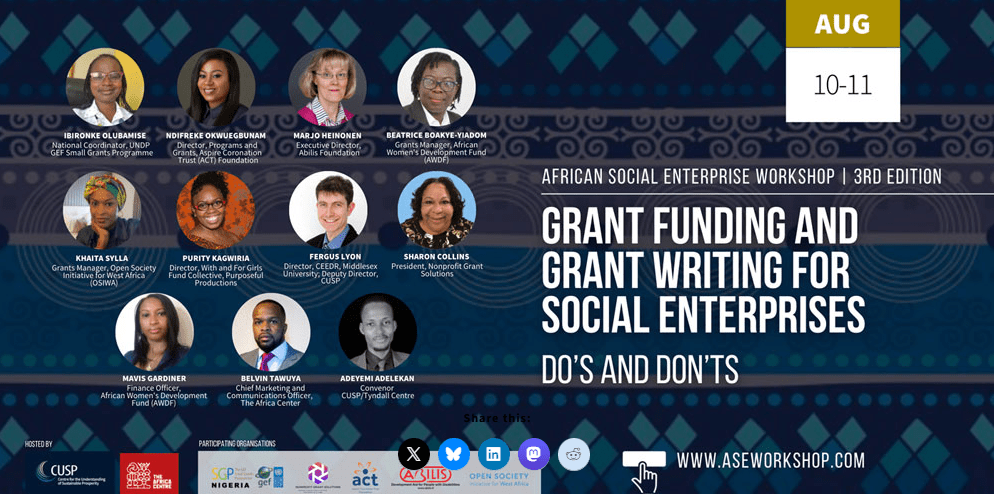
Grant funding and Grant writing for Social Enterprises: Do’s and Don’ts
Finding and securing the needed financial resources to start and scale initiatives for sustainable development can be difficult, particularly in African countries where there are many economic, social, and environmental challenges with limited resources available to tackle them. Grants have been one of the financial vehicles used by local and international organisations to support social enterprises addressing these issues in such contexts but are usually very competitive and requires certain skillsets and experience to successfully navigate its demands. While grantors are never short of applications for funding, majority of grant applications fail, creating frustration and despondency on the part of grant seekers as well as feedback and management pressures on grant makers. What do grant organisations expect from social and environmental entrepreneurs looking for funding and how should applications be tailored to increase their chances of success?
4th Workshop Edition, 2022
Innovating your commercial model for sustainability: Strategies, tools and support mechanisms for African social enterprises
Social enterprises are known to use business means—such as trading products and services—to tackle societal problems. Faced with a myriad of social-economic issues and dwindling charitable funds, new and existing African social enterprises need to develop innovative ways to generate income that can support and sustain their activities in a self-sufficient manner. So, how can social enterprises in Africa do that, and address societal issues in a commercially sustainable and scalable way?
This workshop for African entrepreneurs focused on the enterprise bit in ‘social enterprise’ and explored how alternative businesses can innovate the commercial aspects of their organizations to achieve social goals in Africa.
5th Workshop Edition, 2023
Sustainability through market creation and access: Exploring Opportunities, Barriers, and Strategies for African Social Enterprises
Despite their societal significance, social enterprises in Africa face grave challenges in accessing markets or creating new ones to achieve their social objectives while ensuring commercial viability. These challenges stem from limited resources, inadequate infrastructure, corruption, and regulatory hurdles prevalent in many African countries, which make it difficult for enterprises to achieve their social goals through classic business mechanisms. However, with the emerging African Continental Free Trade Area (AFCFTA), the potential of disruptive technologies, and sustainability initiatives—such as the circular economy—, social enterprises in Africa have a unique opportunity to organize afresh and leverage their innovative capacities for new market creation and market access. The leading question for our two-day workshop was: How can social enterprises in Africa create new markets or access existing ones in a way that is socially, and environmentally—as well as commercially—sustainable?

6th Workshop Edition, 2024
Resourcing Impact: Exploring opportunities, gaps, and strategies for sustaining impact initiatives in Africa
African social enterprises and NGOs play a crucial role in addressing various socio-economic and environmental challenges across the continent. While this is widely acknowledged, understanding how they navigate their resource-constrained settings to address sustainable development challenges remains limited. These impact-focused organisations often face constraints related to resources, hindering their ability to achieve sustainable impact at scale. By understanding, attracting, and effectively managing resources, social enterprises can unlock new opportunities for growth, innovation, and positive change, thereby playing a pivotal role in catalysing the sustainable development of Africa.

Sustainable Futures Seminar Series, 2024
Collaborative Business Models for a Plastics Circular Economy in the UK
Plastics play a huge role in modern life, but their negative impact on the environment and health demands innovative solutions to mitigate their effects. In the UK, less than half of the plastics put on the market are recycled, leading to most ending up in landfills or incinerators. Research emphasizes the need for a unified household plastics collection system, integrating digital technologies to enhance sorting accuracy and value retention in mixed waste streams, thus promoting a circular economy. However, collaborations among organizations are difficult and filled with contestations, particularly around how value is created and captured. In this talk, I discussed the circular business model typologies co-created with stakeholders and the challenges associated with their implementation. I also discussed the assessments and legitimacy judgments informing those contestations and the behaviour of value chain actors that also shape emerging circular economy institutions.

 Dr Adeyemi Adelekan